

2023.12.21
Challenges in public procurement in water and sanitation – part 3
For a long time, the Water Industry Association's member companies have observed recurring obstacles in connection with public procurement in the water and sanitation sector. In a series of articles, we discuss these challenges and present proposals for solutions. In this third article, we address possible contract forms and how to choose the right contract for your procurement.
The dominant contract forms in the water and sanitation sector today are ABT 06 and AB 04 for turnkey contracts and execution contracts. The fundamental challenge with these contract forms is that both ABT 06 and AB 04 are not adapted for deliveries of machinery and process equipment with assembly, but are designed for construction activities in a broader sense. In order to avoid inherent ambiguities when the contracts are to be translated into another type of delivery, it is an advantage to distinguish between construction contracts and functional contracts with clear machinery and process content.
Another form of agreement is ABA 99 which is intended for deliveries of industrial plants. In practice, it has often been used in the delivery of energy production plants and can be used to advantage in the delivery of water treatment plants. The agreement provides both Customer as Supplier increased clarity regarding test operation, takeover and especially during performance tests.
When comparing the agreements regarding inspections and testing, we see that inspection in ABT and AB respectively (Chapter 7, Inspection) is regulated through pre-inspection, final inspection and then final warranty inspection, while in ABA (chapters 10-15) There is an opportunity to specify requirements for self-inspection, tuning, final inspection, test operation and performance testing in more detail.
Performance evaluation
The water industry's recommendation is that contracts that cover any type of function should always have performance evaluation requirements written into them. This is particularly important in a turnkey contract where there is not the same control over the design as in an execution contract.
| ABT/AB | ABA |
| Self-control | Self-inspection (Testing and Inspection) |
| Pre-inspection | – |
| – | Trimming |
| Final inspection | Final inspection |
| – | Trial operation |
| – | Take-over |
| – | Performance test |
| Warranty inspection | – |
Table: Comparison of ABT/AB – ABA regarding inspections and testing. The table comes from Effective Aeration – Design, operation, maintenance and procurement of aeration equipment for municipal wastewater treatment plants, SVU Report No. 2019-23 where the Swedish Water Industry (then Varim) was a co-financier.
When specifying performance or functional requirements, it is important that the requirements are objectively measurable. If you would like to go into more detail, there is a good and well-developed example of an approach for inspection and testing with performance tests that have been carried out for aeration equipment at municipal wastewater treatment plants in SVU report no. 2019-23, Effective aeration, published by Swedish Water Development, where the Water Industry was a co-financier and a member of the project group.
The importance of a well-formulated request for proposal
The water industry also believes that well-designed request for proposals are a very important part of helping Sweden meet its investment needs. The water and sanitation industry is facing a very large investment need in the coming years and the conditions for successful projects are best set with the right conditions. It is important to Customer with technical consultants who often design the request for proposals, and Suppliers can increase their understanding of each other's situation when it comes to conditions and requirements. The common ambition is the same, to ensure sustainable and cost-effective processes in public procurement, which is best achieved with an end result where both parties see the basis as balanced.
The right agreement for the right procurement
The Swedish Water Industry has compiled an overview of the different standard agreements that can be used for water and sanitation projects. The purpose of the table is to facilitate the choice of contract form for a procurement and thereby contribute to increasing the implementation rate of water and sanitation projects.
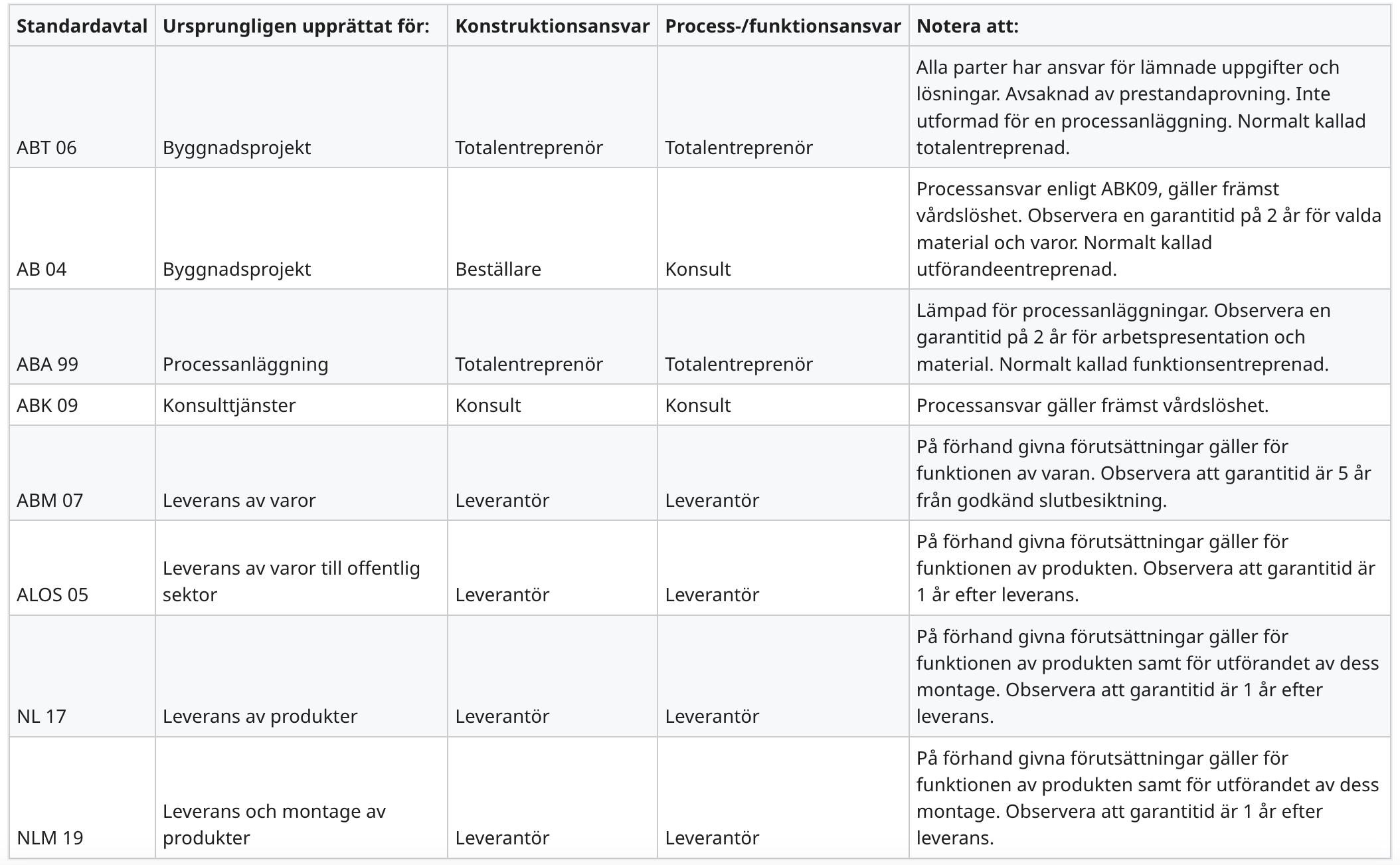
Table: Compilation of standard agreements.
Other proven & working methods
The Water Industry Focus Group for Project Implementation & Procurement also recommends other methods, such as Negotiated Procedure with previous advertisement. The method allows the contracting authority or entity to invite selected suppliers to negotiate improvements to their tenders.
Another recommended method is Competitive Dialogue. With this method, suppliers can apply for, or be invited to participate in, the procurement, provided that they meet the requirements to submit a tender. Dialogue makes it easier for both the client and the supplier and the project.
Eliminate unnecessary risk premiums for more bids
By ensuring that knowledge of and use of the correct form of contracting and associated agreements are used, unnecessary costs for the parties can be reduced. Furthermore, the right procurement method and choice of agreement means that risks are borne by the party best able to eliminate the risk, and thus unnecessary risk premiums and delayed procurement processes can be reduced.
The article is compiled by the focus group for Project Implementation & Procurement within the Water Industry, which works with the long-term goal of creating more effective business processes for the Water Industry.